

Economics Matters — the Newsletter/Podcast/Financial Riddler
Sign up for a free subscription at larrykotlikoff.substack.com. I’ll immediately make it a lifetime subscription. But please support Economics Matters. Just unsubscribe and resubscribe here on a paid basis. Paid subscriptions come with a one-hour, free financial consultation. Email me for a time at kotlikoff@gmail.com. You can unsubscribe anytime and resubscribe for free. Also, please sign up your kids, friends, colleagues, and students!
Dr. Jekyll and Mr. Hyde Mr. Hyde and Mr. Hyde
Let’s be clear. We have a 24/7 madman running our country — straight into the ground. Whether ego, an inner demon, or a foreign power is controlling Trump’s moves is irrelevant. And whether he’s directing events or sitting back and letting his evil henchmen compete to destroy the country makes no difference.
What matters is what’s happened and what might happen. I provide, below, a 20-point partial list of the unthinkables that have happened — things a Manchurian Candidate (MC) would eagerly produce. The list is serious enough for the Wall Street Journal’s conservative columnist, Holman Jenkins, to suggest impeachment and for the New York Times’ conservative columnist, David Brooks, to call for a peaceful uprising. These are two of our nation’s wisest and most respected journalists.
As for what will happen, the likely answers are a deep and prolonged recession, high and prolonged inflation, international isolation, a terrible, endless trade war with China, international sanctions for human rights violations and trading with Russia, the end of American democracy and the rule of law, high inflation thanks both to the tariffs and the decline in the dollar, a major increase in unemployment, a dramatic fall in both the stock and nominal bond markets, an ongoing run on Treasuries, an ongoing decline in the dollar, financial collapse of one or more large financial entities — a collapse that could lead to a widespread meltdown a la 2008, a significant increase in the trade deficit, a sustained, significant rise in mortgage rates, a major contraction in construction, a global recession, the loss of America’s lead in research and innovation, a major realignment of the world order, with our European and Asian allies establishing closer economic and political ties with China, the firing of Fed Chair Jerome Powell meaning the loss of central bank independence, Russian victory over Ukraine followed by war in Europe, and a Chinese invasion of Taiwan.
Yes, this may be miles over the top. Let’s hope so. But many of these things are already in process. As for the most extreme of these potential outcomes — a Chinese invasion of Taiwan, in effectively declaring an economic embargo of China and simultaneously alienating our allies, Trump has removed the major deterrent to such an invasion — global trade sanctions against China. Recall that Pearl Harbor was triggered, in part, by Roosevelt’s embargoing the sale of oil to Japan.
Focusing on Worst-Case Scenarios Is Essential
When we buy homeowners insurance, we go for full coverage, i.e., we protect ourselves against a total loss. The same goes for all other forms of insurance. Worst-case scenarios are of paramount importance because their financial impacts are astronomically worse than all the others.
Wall Street loves to focus on average outcomes. Don’t worry, invest with us. You’ll have an 80 percent chance, on average, of making your retirement spending goal. What Wall Street doesn’t mention is that 80 percent success entails 20 percent failure — a 20 percent chance, on average, of becoming financially destitute in retirement — something that could happen the day after your retirement party! Nor does it clarify the brand of cat food you’ll be eating under the worst-case scenario.
Yes, having your portfolio wiped out due to inane, inept, imbecilic, and intentional MC government policies is a worst-case scenario. But it’s the one that demands your complete attention.
Manchurian Candidate Risk
Standard financial risk due to changing economic and geopolitical conditions is one thing. But Trump has added a new risk — MC Risk. MC Risk is all downside and comes with a fat tail, not to mention a fat head. It’s also long term. Trump has been in office for 88 days. That’s only 6 percent of his four years. Plus, he’s scheming to become dictator for life.
I’m not certified by any Wall Street-approved program to give financial advice. Consequently, I haven’t been brainwashed to believe that stocks are safe in the long run or that bonds are safe in the short and medium term — neither of which is remotely true. Both securities are now incredibly risky thanks to MC risk. Lots of us get this. But most of us are unable to make the financial moves to get out of harm’s way.
Financial Anxiety and Paralysis
I have a non-academic side gig — providing full concierge financial planning using my company’s economics-based financial planning tool, MaxiFi Planner. Some of my clients are rich to super rich. Most are middle or low income. What they all share is extreme financial anxiety, coupled with financial paralysis. They are, like most of us, including yours truly at times, terrified deer caught in the headlights.
Consider Stan, a real client, but with a made up name. Stan’s is a very rich, 65 year-old, single retiree. He has north of 15 million dollars with roughly half of his money in stock. The rest is invested in medium- and long-term nominal bonds. He’s invested this way because his advisor has told Stan to stay the course. “We’ve seen this movie before. Today’s losses will be offset by tomorrow’s gains.”
Trouble is that Stan’s advisor is too young to have seen enough movies. Nothing in economic theory or financial history guarantees that tomorrow’s losses won’t exceed today’s. Between 1929 and 1933, the stock market fell, partially rebounded, fell some more, revived a bit, and then fell again. By 1933, a dollar’s worth of stock held in 1929 was worth 14 cents. It took a quarter century for the market to regain its 1929 value and longer to regain its real value — by which time most people’s trusted advisors had either retired, died, or self fenestrated.
Guiding Stan off the Ledge
I ran Stan through MaxiFi, assuming, to be conservative, that Stan’s investments would earn the program’s default 2 percent real investment return — roughly today’s maturity-weighted return on TIPS — Treasury Inflation Protected Securities. MaxiFi showed that Stan could spend three times more on a sustainable basis than he is currently spending. This came as a great relief. Stan had been holding off spending more in the belief that doing so was unaffordable.
I then showed Stan how using MaxiFi to optimize Roth conversions and move out of New York city to, say, Seattle, (no-state-income-tax) Washington would let him spend substantially more. Stan wasn’t interested in moving. His kids were nearby. But he was keen on reducing his tax payments to the MC via Roth conversions.
We then discussed how Stan might party. A nicer pad? No, been here for years. It suits me just fine. Season tickets to the Knicks? Yes, but in a decade, when they can finally beat the Celtics. Spend a year cruising around the world? I get seasick. A European riverboat cruise. I’ll consider it. Ok, but what are you doing with your time? Hot Yoga and the NY Times Spelling Bee — Takes most of the day, but I generally end up a Queen Bee.
Stan is, in the words of behavioral finance, a habit formation household. He’s in the habit of spending $X per year and is terrified he won’t be able to keep doing so. But he’s also happy with $X per year. Spending more would, it seems, induce guilt.
After determining the size of $X, I set MaxiFi’s spending ceiling at that level. (Note to MaxiFi users: Go to Estate Planning in Settings and Assumptions to set the ceiling. This is a fab new feature!) This directed all unspent resources to Stan’s estate. Stan has children, none of whom are high earners. When I ran MaxiFi, Stan was excited to learn he’d be able to leave each a large-sized inheritance.
Then we discussed Stan’s investments, specifically how quickly and how far Stan’s stocks could fall and the degree to which future inflation might water down his bonds — particularly in light of MC risk. Re his nominal bonds, I pointed out that inflation, post-2019, has increased the price level by 25 percent. Hence, a repeat, which could easily happen, would reduce the purchasing power of Stan’s nominal (non-inflation-indexed) bonds by a quarter.
An Unexpected Question
I asked Stan why he was exposing his kids to so much risk, since it was they, not he, who would likely get wiped out if his highly risky assets continued to decline — as they’d done since the MC’s inaugural?
Stan hadn’t thought about it that way. He said he’d been worried about spending too much.
“But what if I sell my stocks and the market surges like it did under Trump 1? I’d kick himself.”
“Yes,” I said. “you’d kick yourself. But you’ll, figuratively speaking, shoot yourself if the market falls in half as it’s fully capable of doing. Check what happened in the Great Recession, which was just 17 years ago.”
“Right. But it bounced back like crazy.”
“Yes. But there’s no guarantee it would do so again. And if it doesn’t, your kids, not you, will suffer the consequences.”
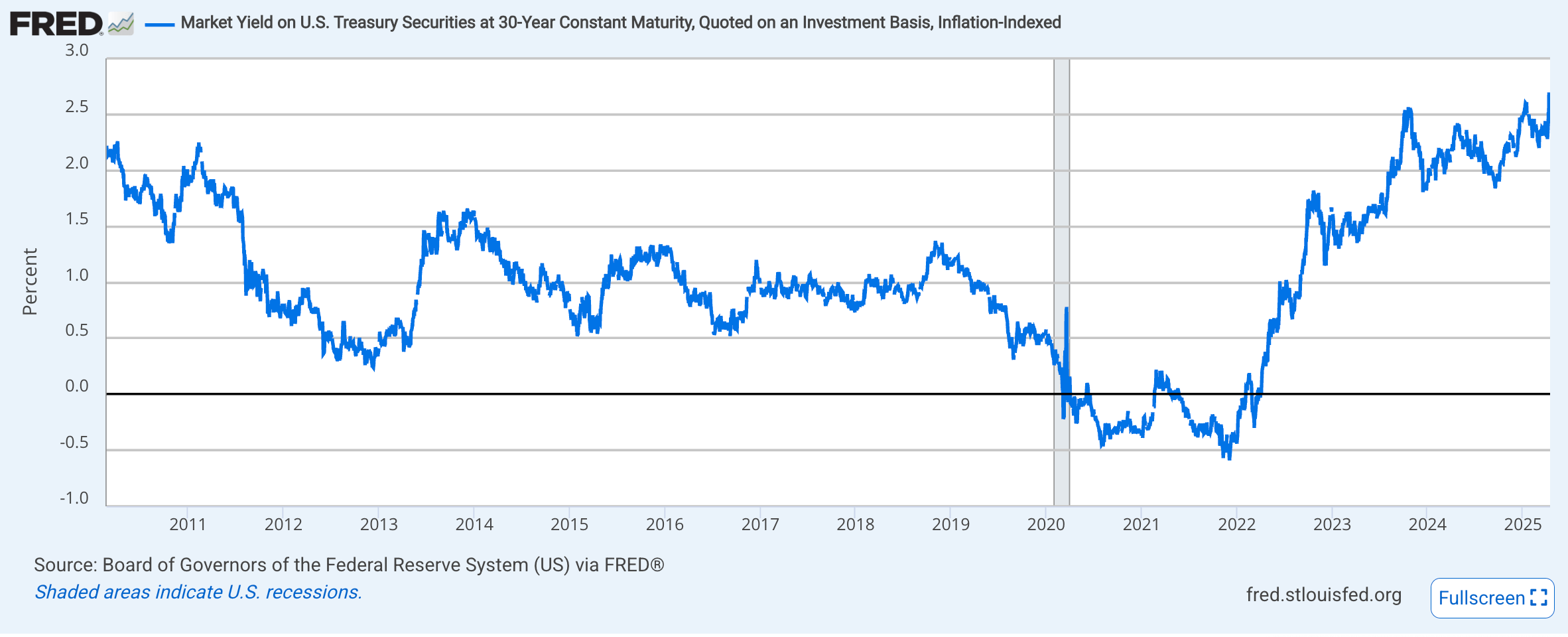
Stan then asked me about safe assets at which point I told him about TIPS, of which, remarkably, he’d never heard. I focused particularly on the 30-year TIP, which, as the above chart shows, is yielding 2.6 percent real — the highest yield recorded in the past 23 years apart from two months. As with other Treasuries, TIPS throw off coupon payments every 6 months. Hence, much of the 2.6 percent real payout on a 30-year TIP arrives in the short and medium term.
“Stan,” I said, “I can’t advise you on how to invest. Wall Street doesn’t certify PhDs in economics to provide financial advice. They need special training to unlearn basic finance. But I can say this. There is nothing wrong in securing your wealth and your children’s financial future. Maybe ask your kids how they’d like you to invest their money. Do they want you to expose them to this much risk?”
Hiding the Bacon
“But they don’t know I have this much money. I’ve never told them. In fact, I’ve spent less than I might have in order to hide my wealth holdings. I wanted them to focus on their own careers and not let my money influence their decisions.”
“Well, their careers are now set, I said. Maybe it’s time to tell them what they effectively own and let them decide how to invest their money. Indeed, maybe it’s time to start making them gifts. From what you’ve told me, they are in far lower tax brackets than you. Hence, if you don’t make gifts, much of their money will go to the MC in higher taxes. If we run them through MaxiFi, we can figure out how much more you’ll provide them, after tax, if you make gifts starting now rather than force them to wait till your death to receive an inheritance. At that point, they may be too old to enjoy what they own.”
Stan said that was a good point and that he’d think about making gifts as well as look into TIPS. I directed him to watch this podcast on building a TIPS ladder if he wanted to immunized spending X through the end of his days. I also told him to watch this one on Upside Investing. Finally, I told him to run Upside Investing in MaxiFi with his $X ceiling turned on. This way he’d see the upside to his estate of leaving different shares of his assets in stocks taking into account his own spending limit. I.e., he’d be able to see the risk to his estate of investing more in stocks and less in TIPS.
Finally, I told Stan to consult with his financial advisor because only he could give him professional advice on investing. I was just there to coach, educate, and provide financial therapy as well as remind him about old movies, including one called The Manchurian Candidate.
Getting to Financial Safety
We don’t stay in an open field when lightening begins to strike. And there is no need to do so when MC risk goes sky high. To repeat, if the stock and bond markets lose value, even major value, there is nothing that guarantees those loses will be offset by future gains. Financial securities aren’t perfect random walks, but they are pretty close. This means that unexpected movements in their prices are caused by new information, which by definition isn’t predictable. Hence, we can’t predict that after, say, a 53 percent drop in the stock market — the drop between 2008 and 2009, that the market will bounce back, let alone when it will do so.
Are TIPS Safe?
Nothing is perfectly safe. TIPS appear to be the safest asset around apart from three risks. The first is the remote possibility that the MC will default on the national debt. TIPS are, of course, Treasury bonds. Hence, a U.S. default would impact TIPS. It would also produce a colossal meltdown of U.S. financial markets, including the market for dollars — far beyond anything we saw in the Great Recession.
My guess is that the minute our MC tried such a stunt, Congress — all of Congress — would kick him to the street. They do, after all, retain the power of impeachment. They might even do so were he to impose a withholding tax (user fee) on interest payments on U.S. Treasuries made to foreigners. That hair-brained idea appears to come curtesy of my former student, Stephen Miran, who received his BA at BU and his PhD at Harvard. Stephen is now Chair of the President’s Council of Economic Advisers.
Stephen, Harvard’s no BU. Best call so I can undo what they taught you. You are far too smart to have conceived this nonsense on your own.
Another TIPS risk is the MC’s potential to lower the official measure of inflation. Messing with the CPI would, however, mean messing with the indexation of Social Security benefits of over 70 million beneficiaries, some 40 million of whom vote. They would likely march on Washington — all with walkers — and dare the MC to physically attack them. So, no, I don’t think Trump will play games with the CPI.
The third risk — the taxation of the TIPS’ inflation protection (Uncle Sam taxes nominal, not real asset income) — is potentially substantial if inflation kicks in. Hence, if you buy TIPS, it’s best to do so inside retirement accounts. Doing so in taxable retirement accounts will defer taxation of phantom income (the TIPS inflation adjustment) until you withdraw your assets. Even better, hold TIPS in your Roth accounts since no tax whatsoever is due on Roth withdrawals.
Other Strokes for Different Folks
I’ve been mostly thinking about retirees who feel compelled to invest in the market for fear of missing an upturn. They can have their cake and eat it to by running MaxiFi’s Upside Investing that assumes all investment are in either stocks or TIPS, but all spending is based solely on TIPS. The only way stocks lead to higher spending is when they are sold and used to buy additional TIPS. MaxiFi lets your see the tradeoff between a higher living-standard floor and a lower upside versus a lower living-standard floor and a higher upside. Virtually all of us should, I believe, be using Upside Investing to make investment decisions.
But what if you are 45 and investing is not an issue as you haven’t saved much to date? The real question, in your case, is securing your human capital and not overspending on housing or taxes. Thus, if you can move from a high-tax, high-priced, insecure job in, say, super expensive New York City, to a somewhat lower paying job in no-income-tax, low-cost Tennessee — a job with far more staying power, that may be just the ticket. This is particularly true if you have a fair amount of home equity since housing in Tennessee is dramatically cheaper than in Gotham. MaxiFi can, of course, compare your sustainable living standards across the two options. Imagine moving to Tennessee and having enough extra spending power to buy season tickets to the Celtics as well as afford the travel costs to Boston!
The MC’s First 87 Days
The declaration of total economic trade war with China, which now faces 245% tariffs on all exports
The levying by China of 125% retaliatory tariffs on the U.S.
The levying of 25% U.S. tariffs on steel and aluminum
The levying of a 10% tariff on global imports
The imposition of draconian additional tariffs on most other countries, but the pausing of these tariffs pending negotiations on country-specific bases accompanied by a warning that any negotiated deal might be changed
Reports suggesting that tariff negotiations will pressure countries to stop trading with China
A Chinese retaliatory export ban of rare earth and other minerals to the U.S. that, according to the White House, are “central to automakers, aerospace manufacturers, semiconductor companies and military contractors”
The likelihood that China is quietly telling countries they can trade with China or the U.S., but not both. Most counties will likely go with China. Chile, for example, does four-times more trade with China than with the U.S.
A plunge in consumer confidence to its second lowest recorded level since the index was formed in 1952
A tripling of stock market volatility since the election
A wholesale attack on basic government research
A wholesale attack on federal agencies, including mass firings and resignations of the most experienced staff
A wholesale attack on American universities, particularly our top universities, and particularly scientific and medical research
Suspension of habeas corpus for non-U.S. citizens
A growing global boycott of American goods and services as well as travel to the U.S.
Disregard of and disrespect for the rule of law
Threatened use of military force against our allies
The imminent cessation of U.S. military aid to Ukraine coupled with unilateral concessions to Russia
The marked erosion of faith in and the prices of U.S. Treasuries and the dollar
Threatening to fire Fed Chair, Jerome Powell, and eliminate the Federal Reserve’s independence
Larry, well said on all points. Thank you for your work and for your concern for our nation and its people. I am 74, retired, and heavily invested in very broad index funds for both bonds and stocks, per the teaching of the late John Bogle and his Bogleheads. I have been way too long moving to a far less risky portfolio, about 5 months late for sure. I own MaxFi Planner and have not applied it due to fear it is way over my financial head. That will change. Carry on.
I don't know... Things seem to be going pretty well. We are in drastic need of a new way forward.