


Economics Matters — Blog/Podcast/Financial Riddler/MaxiFi Puzzler
Sign up for a free short-term subscription at larrykotlikoff.substack.com. I’ll immediately make it a free lifetime subscription. Also, pls sign up kids, parents, … — everyone you know.
Paid subscriptions come with a monthly Q&A session via Substack Live. I’ll email you the day and time. Submit questions on anything and everything via chat. I’ll be live.
Subscribe as a Founding Member - Help me provide high-level economics content and break even covering my significant podcast costs. Comes with a one-hour financial therapy session (kotlikoff@gmail.com) and full access to my monthly Q&As sessions.
Teaching Financial Literacy/Economics at any level? Email me for free MaxiFi licenses for your students and a free PRO license for yourself. kotlikoff@gmail.com
Speaking Inquiries — visit www.chartwellspeakers.com
Disclaimer: Any opinions expressed in Economics Matters’ posts are those of the authors and guests. These are not the opinions of Boston University or Economic Security Planning, Inc.
Military Career Decisions Are Tough and Ongoing
Some 2.1 million young, middle aged, and older Americans serve our nation either as active duty military or members of either the National Guard or the Reserves. After their generally four years of active duty, service members must decide whether to reenlist, separate, or switch from active duty to serving either in the National Guard or the Ready Reserve.
These decisions involve, of course, a host of non-financial factors, including missing family and pride in defending our country. Economics can only clarify financial tradeoffs. My company’s personal financial planning software, MaxiFi Planner, which is 33 years in the making, measures those tradeoffs. MaxiFi does economics-based financial planning, which seeks to raise, sustain, and protect households’ living standards. One of MaxiFi’s many strengths is comparing different career paths based on their lifetime-spending impacts.
A Word on Economics-Based Financial Planning — for MaxiFi Newbies
When I say “economics-based personal financial planning” I’m referring to simultaneously solving the highly complex equations formulated, over the past century, by the fathers of finance. The list includes seven economics Nobel Laureates, the polymath, John von Neumann, who co-developed, with Oscar Morgenstern, economics’ general approach to uncertainty (in between working on the atomic bomb and designing the first modern computer), Irving Fisher, who developed the economics of lifetime saving and spending, and Menahem Yaari, who clarified and unified the economics of mortality (life) and longevity (annuity) insurance.
Personal financial economics consists of a large set of interconnected equations whose joint solution delivers internally consistent saving, spending, career, insurance, investment, location, housing, retirement-account management (including contributions, withdrawals, and Roth conversions), tax minimization, and Social Security benefit maximization plans that are a) affordable, b) respect cash-flow constraints, and c) deliver, on average, your highest level of lifetime well-being given your degree of risk aversion (risk tolerance).
MaxiFi is taught to advanced students in finance at MIT by Nobel Laureate Robert Merton, who the late Paul Samuelson called “The Issac Newton of Finance.” But it’s also used by tens of thousands of households for whom math is a distant nightmare. They use it because MaxiFi’s heavy duty math and computational algorithms are buried deep under its hood. Above its hood, MaxiFi is easy peasy.
Bankrate recognized MaxiFi’s ease of use, amazing accuracy, and scientific basis in naming it “Best Personal Financial Planning Software of 2025.” And MaxiFi’s reports confirm at a glance that the program’s results are internally consistent, affordable, and correct.
How does economics-based and conventional financial planning differ? Conventional tools were carefully crafted to stealthily transfer money from your pocket to Wall Street’s. Its simplistic, if crafty bait-and-switch methodology, which AI is now aping, bears no resemblance whatsoever to the economics of personal finance. If this sounds exaggerated, please read this, this, this, this, and this. Also, ask yourself why no economics or finance PhD program teaches conventional planning at any top university anywhere on the planet.
Pensions and Healthcare Carrots for Service
Serving on active duty for 20 years provides a pension that begins at separation. Many active duty military take their pensions and separate at 20 years. They do so thinking this is their best financial move. For many/most, that may well be the case. But serving beyond 20 years can materially increase one’s pensions — for a reason. The formula depends on years of service and the average of the three highest years of pay — both of which will rise with service. Once started, active-duty-based pensions increase annually in line with inflation.
For those in the Guard or Reserves, 20 years of qualifying service also secures a CPI-indexed pension, but one that starts at age 60. A qualifying year requires at least 35 days of service. More service days in a given year won’t count toward more qualifying years. But they will deliver a higher monthly payment via the applicable pension-benefit formula. As for your highest 36 months of pay, the military effectively indexes this to growth in military compensation. Specifically, it considers the pay of those with your final grade and years of service when you reach age 60.
Receipt of your pension also triggers eligibility to purchase TRICARE — military healthcare coverage. Active duty military receive essentially free healthcare while serving or receiving a pension based on 20 years or more of active duty.
Guards/Reservists can purchase very inexpensive TRICARE while serving. If they retire having qualified for a pension starting at 60, they can continue purchasing TRICARE, but at a higher price. But once they reach age 60 and start collecting their pension, that price drops substantially.
Finally, if you’re on active duty, you can receive BAH (Basic Allowance for Housing) and BAS (Basic Allowance for Subsistence) support. These major benefits are also available to Guard and Reserve members but only when they are on active duty for at least a month.
Illustrating MaxiFi’s Ability to Guide Military Service Decisions
Joining the regular military, signing up with the National Guard, choosing to re-enlist, and picking a date to retire — these are all decisions that MaxiFi can help prospective and current service members make. Let me illustrate MaxiFi’s capacities for the case of a hypothetical 34 year old named Peter.
Peter enlisted in 2010 as a Private (E-1) at age 18. His starting salary was $19,107. He’s now a Sergeant First Class (E-7) earning $72,011. Peter is considering staying in the military through age 47 at which point he expects to be a Sergeant Major (E-9) earning, in today’s dollars, $99,047.
Peter is a highly skilled mechanic. He plans to work in that occupation from age 48 through retirement at 62, earning a projected $80,000 in today’s dollars. Peter further plans to take his reduced Social Security retirement benefit at 62.
Since Peter will have completed more than 20 years of active duty, he can start his pension at 48 when he separates from the army. Peter had the option to switch to the BRS pension system, but chose the legacy High-3 system instead. His annual pension starting at 48 will, therefore, equal $68,592 each year. This amount is net of the monthly premium needed to provide Joan with 55% of Peter’s benefit if he dies. The bad news is that military pensions are subject to federal income taxation. The good news is that Virginia exempts military pensions from what would otherwise be a roughly 5% rate. (Btw, since MaxiFi is obsessed with sweating the details, it gets state taxation of military pensions exactly right.)
Peter is married to Joan who is 30. They have two children, ages 2 and 5. Joan works in the local library earning $50,000. She expects her pay to stay fixed in today’s dollars through retirement at age 62, which is also her planned Social Security early start date. Like Peter, Joan has a good Social Security earnings record. She’s been working since age 20, when her nominal salary was just $38,000. Since then, it’s grown by 3 percent, in nominal dollars, year after year.
Given their location in Norfolk, Virginia, Peter’s annual BAH is a sizable $30,900. His annual BAS is $5,723.40. Both income streams are exempt from federal, state, and FICA taxation. And both amounts will, Peter assumes, keep even with inflation.
The couple has $75,000 in their checking account. As for housing, they now rent for $3,000 per month, but plan to buy a $350,000 house (measured in today’s dollars) in five years. They’ll take advantage of a 30-year VA Home Loan with its zero downpayment requirement. They expect the preferred VA Home Loan mortgage rate will be 5 percent when they buy. What about annual maintenance, insurance, and property taxes? They’re looking at an annual total cost, measured in today’s dollars, of $13,000.
What about TRICARE heath care costs? They’ll run Peter and Joan $765 per year until Peter reaches age 65 and takes Medicare. Thereafter the cost goes to zero. Finally, the couple projects inflation will average 2% and that they’ll be able to earn, on average, 4% on their savings.
Entering these data in MaxiFi took Peter and Joan a half hour. To double check their inputs, they chose to purchase MaxiFi Premium Plus, which provides a flight check. That check is conducted by Kara and Mark Brandt. Both are former Air Force pilots. Kara flew the C-5 and Mark flew the U-2. Nicer folks you won’t meet.
Peter and Joan’s Base Plan
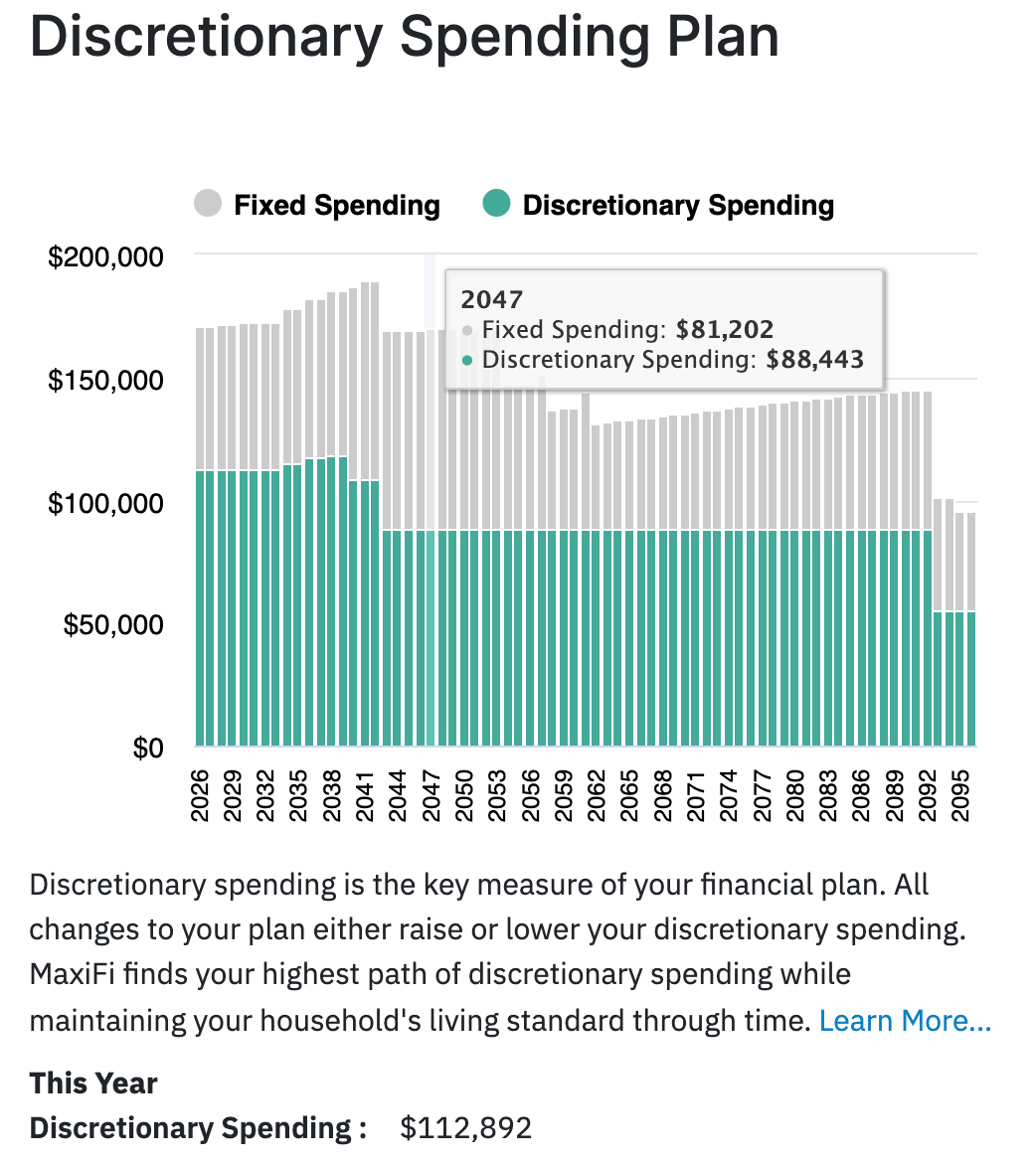
The chart below shows the couple’s annual discretionary spending. All amounts are in today’s dollars. Discretionary spending is all outlays apart from taxes, housing expenses, special expenses (on TRICARE in their case), life insurance premiums (internally calculated by MaxiFi based on its life insurance guidance), and Medicare Part B premiums.
MaxiFi defines a household’s living standard in a given year as its discretionary spending per household member (with adjustments for economies of shared living and the lower cost of children) in that year. Peter and Joan asked MaxiFi to find the affordable path of annual discretionary spending that would provide their household the same living standard per member through their assumed age-100 maximum ages of life subject to not putting them in debt. (This is MaxiFi’s cash-flow constraint.) As the chart shows, the couple spends more when the kids are home as well as more when both spouses are alive. Also, in their early years, they are somewhat cash constrained.
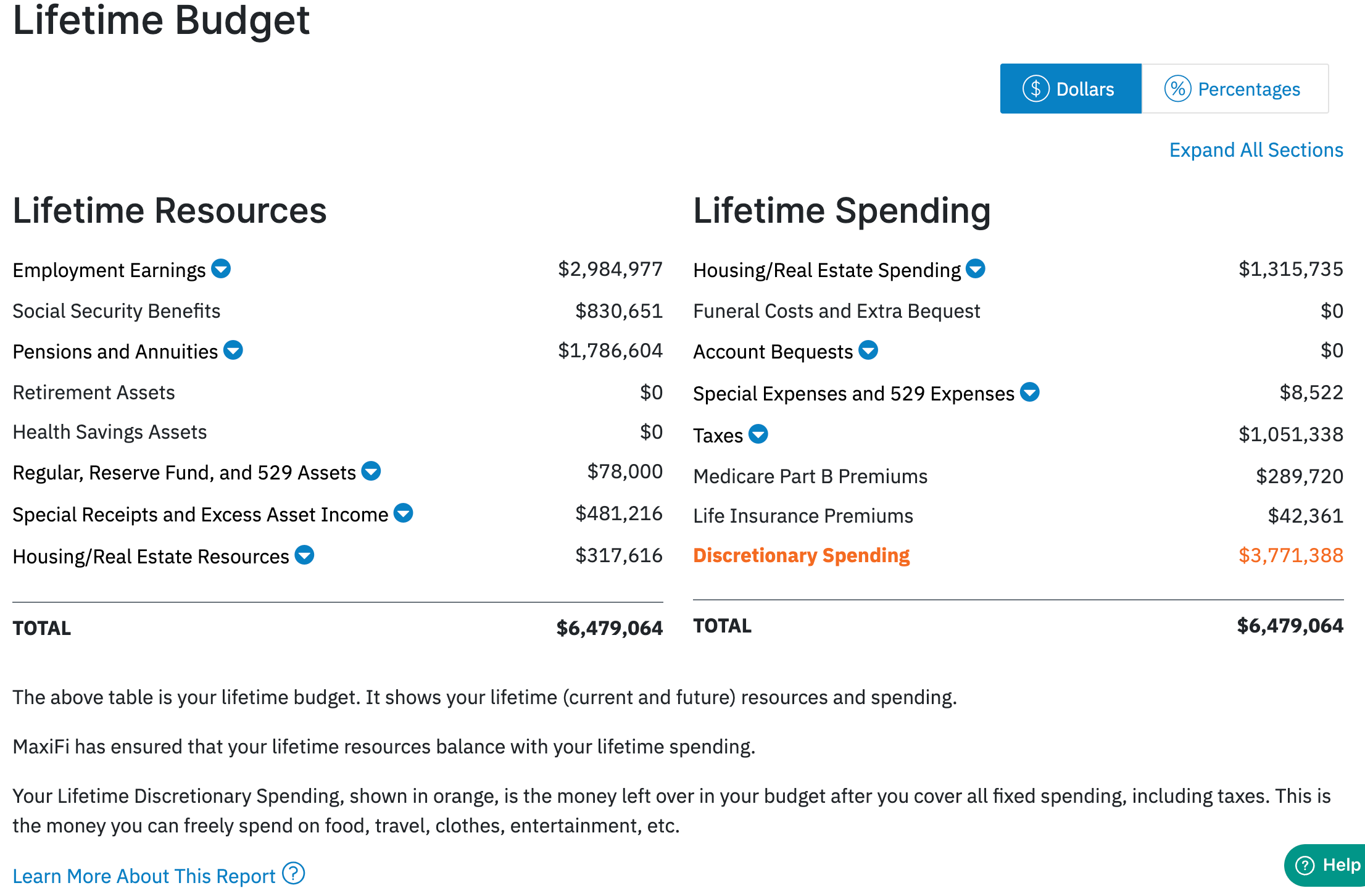
The couple’s lifetime budget, shown below, conveys a critically important and reassuring message. Peter and Joan’s plan is affordable. The sum of the couple’s resources equals the sum of its outlays with all amounts measured as present values.
Retiring After 20, Not 30 Years of Active Duty
Peter and Joan like their plan, but Peter’s having second thoughts about spending another 14 years in uniform. If he signs up for just four years, he’ll be able to take his pension at 38 when he completes 20 years of active duty. Yes, it will be lower than if he serves for 30 years or something in between. Indeed, if he separates with 20 service years, his pension will be only $32,956 net of premiums to protect Joan. That’s less than half the pension he’ll start receiving if he serves for 30 years. But he’ll receive it for an extra 10 years. And yes, he’ll forgo ten years of BAH and BAS. On the other hand, TRICARE will be as incredibly inexpensive starting at age 38 as it will be starting at age 48.
Peter sets up an alternative profile in MaxiFi called Retire After 20 Years of Service and then compares it with his base plan (serving for 30 years). Here’s what he sees.
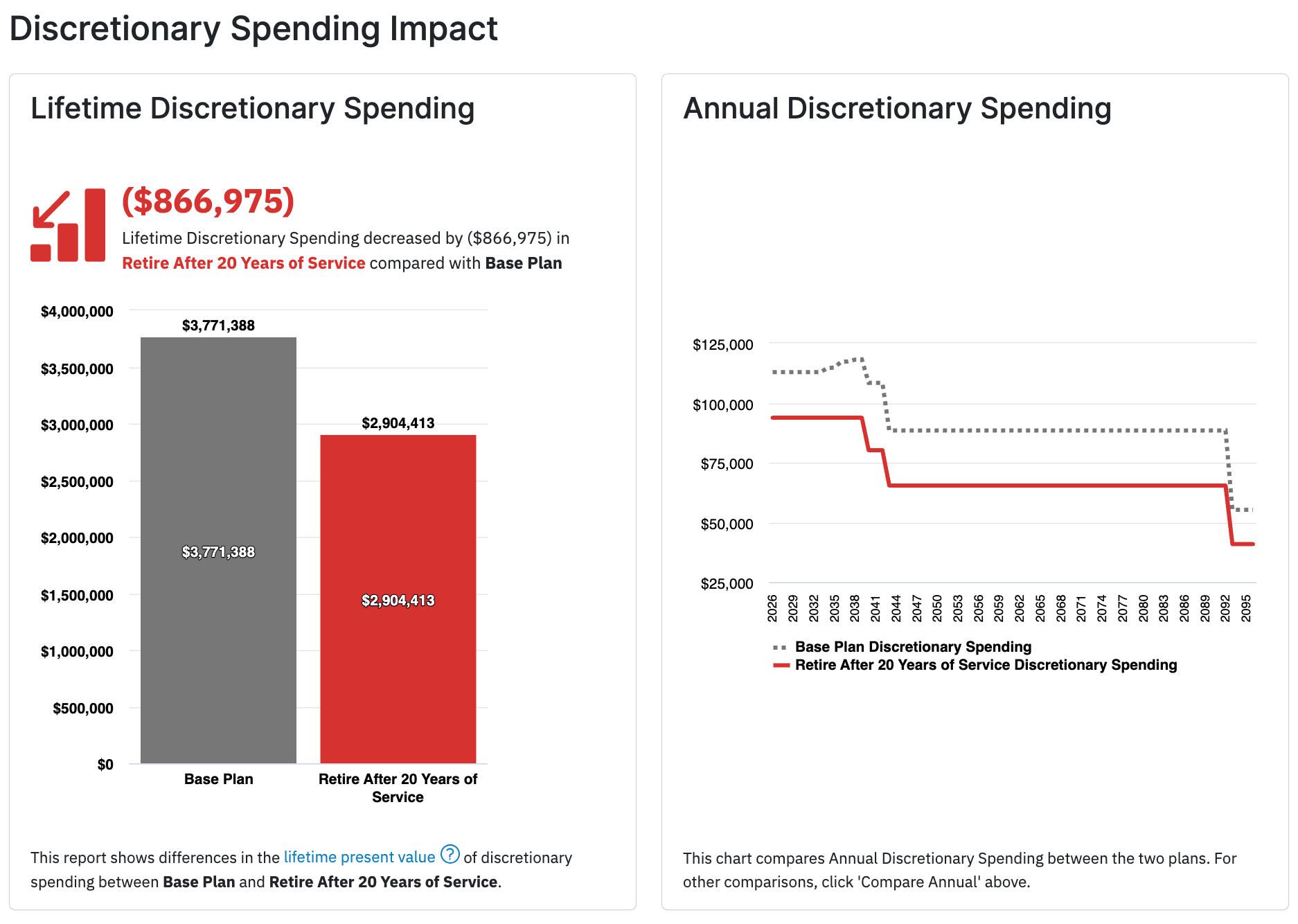
Retiring after 20, not 30 years from the military comes at a major present value lifetime discretionary spending cost, namely $855,975. The table below decomposes the loss. The main driver is an almost $1 million reduction in the combined present value of pension, BAH, BAS, and labor earnings, partly offset by lower lifetime taxes and Medicare Part B premiums.

Peter Goes for 30, But Also Uses MaxiFi to Safely Raise Living Spending
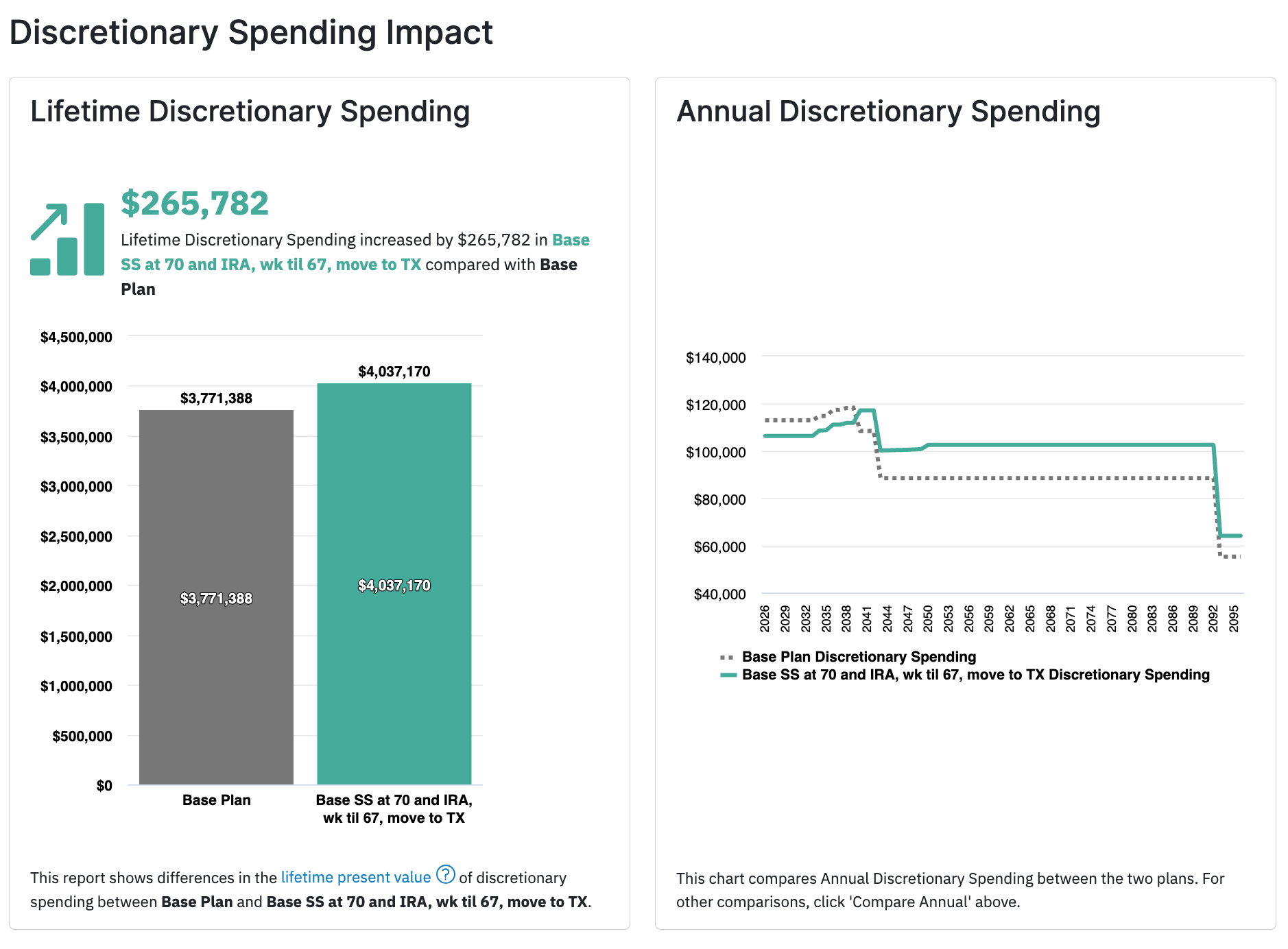
Once Peter sees the cost of retiring after 20 rather than after 30 years he decides to stay on active duty through age 48. Yes, he’ll need to keep saluting newly minted officers who are younger than his children. But the ability to double his pension and retain all the housing and subsistence support is too hard to give up. Peter’s happy that he and Joan are making a precision decision, not guessing at what’s best, at least financially speaking. After reading about MaxiFi’s other capacities, Peter and Joan build a third profile that has them a) take their Social Security retirement benefits at 70 and b) each contribute the maximum amounts possible to IRAs, with Joan contributing starting immediately and Peter starting his contributions when he leaves the military. They also specify they’ll work till Peter reaches 67 and then move to Texas to avoid state income taxes. Their plan is to rent in Texas for $3K a month to release the equity in their house to help finance their retirement. Here’s what they find — a $265,782 pot of gold that’s roughly the after-tax equivalent of Peter working another five years as a mechanic! This increase in lifetime discretionary spending is correct to the dollar as one can verify based on MaxiFi’s detailed reports.
Final Thoughts
The above may sound like a long-winded advertisement for my company’s software. It’s not. I’m an academic. I get paid well by Boston University. I work for free for my company and have done so for 33 years. My goal for MaxiFi is the same today as it was when I founded the company in 1993 — to hire extraordinarily dedicated people, including ex-military or members of military families, to provide economics’ extraordinary powerful financial guidance to the public at the lowest possible price. There is no one more deserving of that assistance than current and former members of our military.
as an Afghan veteran who was left behind after so many promises from the current U.S. government,this part about planning for military families really hits home for me. Service members give years of their life believing the system will take care of them. I only wish the same level of planning and responsibility was shown when Afghan veterans like me were promised support and then left behind