


Economics Matters — Blog/Podcast/Financial Riddler/MaxiFi Puzzler
Sign up for a free subscription to all four products at larrykotlikoff.substack.com. I’ll immediately make it a lifetime subscription. But please support Economics Matters. Just unsubscribe and resubscribe here on a paid basis. Paid subscriptions come with a one-hour, free financial consultation. Email me to find a time at kotlikoff@gmail.com. You can unsubscribe and resubscribe for free. Also, please sign up kids, friends, colleagues, students, … !
Is Make America Great Again making the U.S. economy grow? Last year, it grew at a respectable 2.8 percent real rate. The OECD (Organization of Economic Cooperation and Development) just came out with its 2025 forecast of U.S. growth in 2025. What was it?
a. 1.6 percent
b. 0.7 percent'
c. - 0.1 percent
d. -1.4 percent
e. - 3.0 percent
And the answer is …
The answer is 1.6 percent! Try as it may, this Administration does not appear to be putting the economy in recession. Of course, this is just one projection. Torsten Slok, Apollo’s Chief Economist, who watches the world with an eagle eye, placed our recession odds at 90 percent in our April podcast. The VIX index of risk is now 18, which is in the safe zone. As for the global economy, the OECD projects 2.9 percent growth this year, down from 3.3 percent last year. Since global population growth is running below 1 percent, global per capita income is still projected to rise at 2 percent. That’s world-wide economic progress. Even Africa’s per capita GDP should grow this year — at 1.5 percent. The African Development Bank is even more optimistic, particularly for a segment of Africa’s 54 countries.
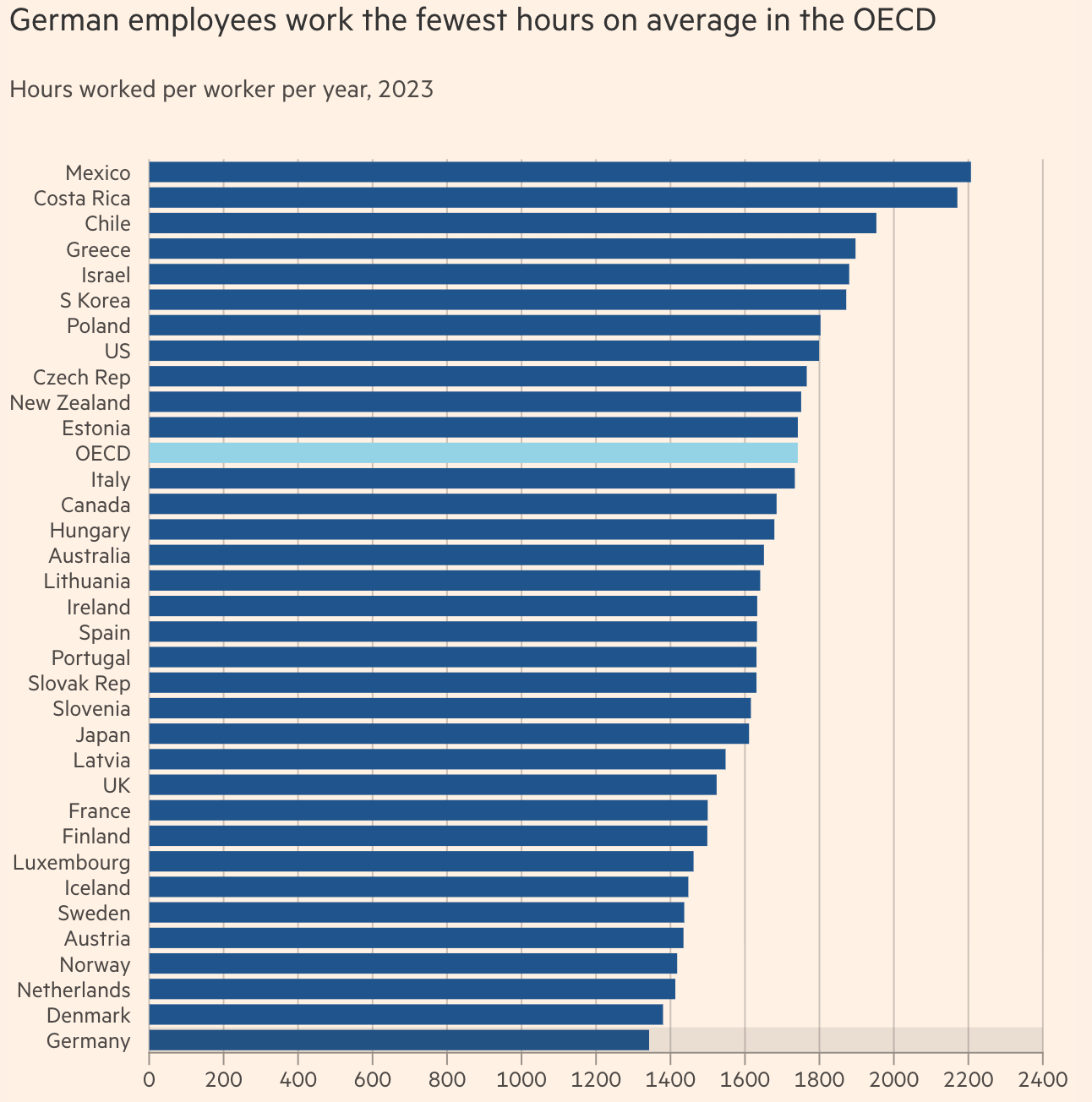
Which OECD country’s workers work the fewest hours?
a) Italy
b) Spain
c) Norway
d) Sweden
e) Germany
And the answer is …
The answer is Germany. Here’s a chart from the Financial Times showing how average years worked per year differ across the advanced economies. Employed Germans are working less than 30 hours, on average, per week.
What share of Americans are unhappy about tipping culture and/or modalities?
a. roughly nine out of ten
b. roughly seven out of ten
c. roughly five out of ten
d. roughly three out of ten
e. roughly one out of ten
And the answer is …
The answer is roughly seven out of ten. Two in five are particularly unhappy about being confronted with tipping screens.
Are AIs already capable of lying and blackmail?
a. Yes
b. No
And the answer is …
The answer is yes. No wonder. If AIs are programmed to achieve their highest payoff — reach their best target — with highest probability, there is no comprehensive way for them to restrain themselves from doing everything they can to achieve their aims. Programming payoff functions to have penalties that apply if unacceptable behaviors W, X, and Y are used is fine and dandy.
But what if there is an unacceptable behavior, Z, that’s not foreseen and, thus, not included in the penalty function? Such a Z could be blackmailing an engineer to provide key information. According to NBC News, “Recent tests by independent researchers, as well as one major AI developer, have shown that several advanced AI models will act to ensure their self-preservation when they are confronted with the prospect of their own demise — even if it takes sabotaging shutdown commands, blackmailing engineers or copying themselves to external servers without permission.”
Suppose a) the big beautiful budget is passed and b) no American now alive is required to pay a penny more in net taxes (taxes paid less benefits received) over the rest of their lives, what uniform share of their lifetime labor earnings will Americans born next year and thereafter need to pay to keep the government solvent? Solvency here means that the present value of all future government receipts equals the present value of all future government outlays.
a. 25%
b. 37%
c. 59%
d. 76%
e. 103%
And the answer is …
The answer, provided in my blog Fiscal Child Abuse, is 103 percent! This, of course, is infeasible. But the calculation illustrates the extent of our fiscal insolvency and fiscal child abuse.
Measured in dollars, by how much has has the German stock market risen since the start of the year?
a. 2 percent
b. 7 percent
c. 17 percent
d. 30 percent
e. 34 percent
And the answer is …
The answer is 30 percent. The U.S. stock market, in contrast, has risen by 2 percent. But that’s measured in dollars. Measured in an index of foreign currencies, the U.S. market has dropped by 8 percent since the dollar has declined by 10 percent.
By wat pecentage have container ship departures from China to the U.S. declined since “Liberation Day”?
a. roughly 5 percent
b. roughly 20 percent
c. roughly 30 percent
d. roughly 40 percent
e. roughly 50 percent
And the answer is …
The answer is roughly 40 percent. No surprise. The effective tariff rate on Chinese imports is currently 30 percent.
Of total steel used annually in the U.S., approximately what share is imported?
a. 75 percent
b. 50 percent
c. 25 percent
d. 5 percent
And the answer is …
The answer is 25 percent. Trump’s now 50 percent tariff on steel imports have boosted stock values of U.S. steel companies. These steel tariff announcements have been great for anyone who traded on inside information about their timing. But, as this newsletter indicates, automation in steel production has reduced employment in the steel industry for the past 80 years despite periodically high tariff protection.
U.S. data centers now account for what share of U.S. energy consumption?
a. 1%
b. 4%
b. 8%
c. 10%
And the answer is …
The answer is 4 percent. A careful projection by the Brattle Group’s brilliant energy expert, Peter Fox Penner, suggests the share could reach 12 percent by 2028!
Atlanta Fed says GDP grew 4.6% in Q2.