


Economics Matters — Blog/Podcast/Financial Riddler/MaxiFi Puzzler
Sign up for a free subscription to all four products at larrykotlikoff.substack.com. I’ll immediately make it a lifetime subscription. But please support Economics Matters. Just unsubscribe and resubscribe here on a paid basis. Paid subscriptions come with a one-hour, free financial consultation. Email me to find a time at kotlikoff@gmail.com. You can unsubscribe and resubscribe for free. Also, please sign up kids, friends, colleagues, students, … !
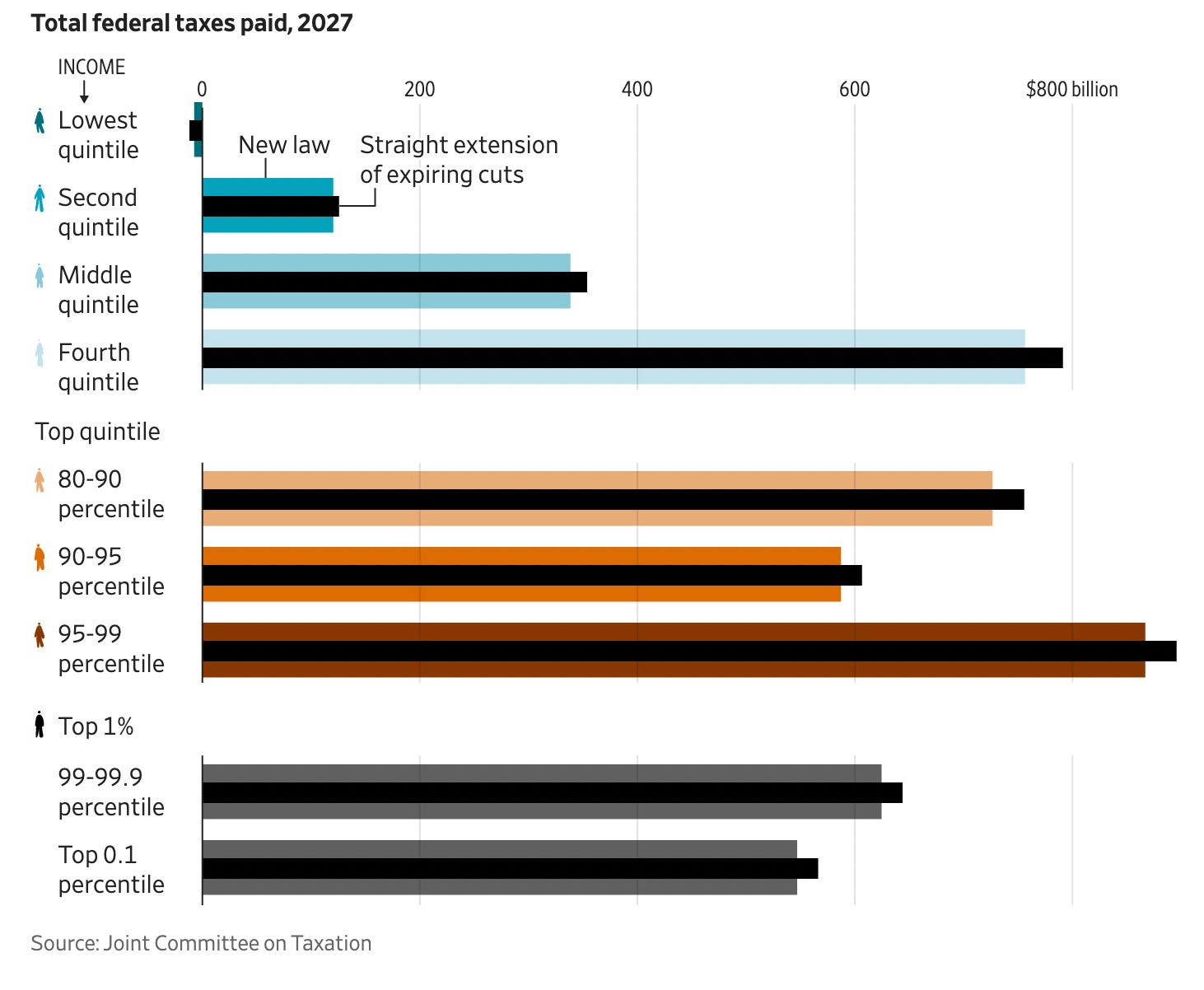
Compared to this year’s tax provisions, did the Big, Beautiful Budget Bill dramatically cut Americans taxes?
a. Yes
b. No
And the answer is …
The answer is no. See the chart below from the Joint Committee on Taxation. The modifications to the Tax Cut and Jobs Act, which everyone knew would be renewed, are small. The Big, Beautiful Budget Bill is neither big nor particularly beautiful. Instead, it’s a big deal about very little.
Do tariffs need to raise import prices to make us worse off?
a. Yes
b. No
And the answer is …
The answer is no. Uncle Sam is, as of yesterday, going to tax Italian Chianti at a 15 percent rate. Suppose you live with your parents and spend all your salary on two things — red-blooded American hamburgers and Chianti. Also suppose the price of Chianti doesn’t rise, but the price of hamburgers falls, leaving the price of Chianti relative to hamburgers 15 percent higher. Further suppose your salary falls to the same degree as the price of hamburgers. You’re worse off. Yes, you have the same hamburger purchasing power, but 15 percent less Chianti purchasing power. Yet the price of Chianti hasn’t budged.
The economic loss to you is, to a first approximation, the number of Chianti bottles you were purchasing times 15 percent times their initial price. U.S. imports total roughly $4 trillion dollars. Multiply this by 15 percent — my assumed final average Trump tariff rate — and we’re talking $600 billion. That’s a 12 percent tax hike. Yes, the price of Chianti might not rise 15 percent relative to American-produce hamburger meat. And it wouldn’t if we were the only buyers of Chianti. But we only account for 15 percent of total world consumption making us too small to matter to the global price of Chianti.
The impact of the tariffs on your grocery bag’s content will work their way through time. It will take Chianti producers time to find more customers in China and elsewhere as they lower sales to American customers. And US wages may end up growing at a slower rate in the process. Bottom line. Keep an eye on what ends up in your grocery bag.
Is California gaining or losing population?
a. Gaining
b. Losing
And the answer is …
Despite worsening natural and man-made disasters and recording the highest or near highest levels of poverty, homelessness, unemployment, utility costs, housing prices, and educational failures, California continues to gain population. Some 40 million Americans — one in eight — live in California, even though the state accounts for less than one twentieth of the nation’s land mass. Texas is experiencing the largest population growth — over a half million between 2023 and 2024. Meanwhile, West Virginia, Mississippi, and Vermont is losing population, albeit not at lot.
How many countries are there in the Eurozone?
a. 9
b. 15
c. 20
d. 31
e. 35
And the answer is ..
The answer is 20. The European Union has 27 member countries, but 7 — Bulgaria, the Czech Republic, Denmark, Hungary, Poland, Romania, and Sweden — have their own currencies.
Do males have higher average SAT scores than females?
a. Yes
b. No
And the answer is …
The answer is Yes. In 2023, the average male score was 1032. The average female score was 1023. These averages pertain, of course, only to those who apply or consider applying to college. That’s a far smaller share of males than females. An astonishing 58 percent of undergraduates are female. What’s needed is affirmative action for males.
Compared with last year, by what percentage have animal surrenders increased in Charlotte-Mecklenburg, North Carolina? Animal surrenders references people leaving their pets at animal shelters, generally out of financial need.
a. 11 percent
b. 15 percent
c. 23 percent
d. 43 percent
And the answer is …
The answer is 43 percent. This report, from CNN, suggests animal surrenders may be a novel early indicator of economic downturn.
What share of veterinary students are female?
a. 30 percent
b. 50 percent
c. 60 percent
d. 70 percent
e. 80 percent
And the answer is …
The answer is 80 percent. What about the female share of law students? It’s 56 percent.
How long, on average, do storefronts in Manhattan stay empty?
a. 5.1 years
b. 3.9 years
c. 2.2 years
d. 1.5 years
e. 7 months
And the answer is …
The answer is 1.5 years and more than half stay vacant for over one year. This finding is reported in a study by economists Erica Moszkowski, at the University of British Columbia, and Daniel Stackman, at the Federal Trade Commission. Landlords, they eplain, aren’t waiting for better economic times. They are waiting for tenants with particularly high demand for their storefronts — tenants who will wish to sign long-term leases to justify the expensive, specialized investments they will need to make to transform the space as needed.
The market for retail space is very different from that for new homes. A new home buyer needs to worry about undisclosed, expensive problems. Hence, a house that doesn’t sell quickly produces a stigma called weeks on market. That information problem doesn’t arise in storefront or rental housing markets. Hence, waiting, potentially for years, to find the right renter can make sense. But vacant storefronts downgrade their neighborhoods, making other stores harder to rent and leading other renters reluctant to renew. This is a negative economic externality that can be corrected with a vacancy tax. But the authors suggest that the optimal vacancy tax, at least in Manhattan, isn’t very high. Here’s an excellent article by Seth Zeren explaining the many reasons for empty store fronts. Remarkably, we don’t have national stats on the share of US towns and cities with significant empty retail space, nor those that have entered a death spiral due to too many boarded up shops. Nor do we know much about the share of towns who have seen their downtowns destroyed by Amazon and other online retail.
What fraction of homes are mortgaged?
a. 80 percent
b. 70 percent
c. 60 percent
d. 50 percent
e. 40 percent
And the answer is …
The answer is 60 percent.
The Chianti v Hamburger price scenario was difficult to understand because it is hard to imagine hamburger prices and salaries falling any time soon. IMO, how much Chianti exporters absorb tariffs depends on the microeconomics of their individual business. Businesses must cover at least their fixed costs to remain viable. If they are operating on that margin already, they will not be able to absorb any of the 15% tariff.